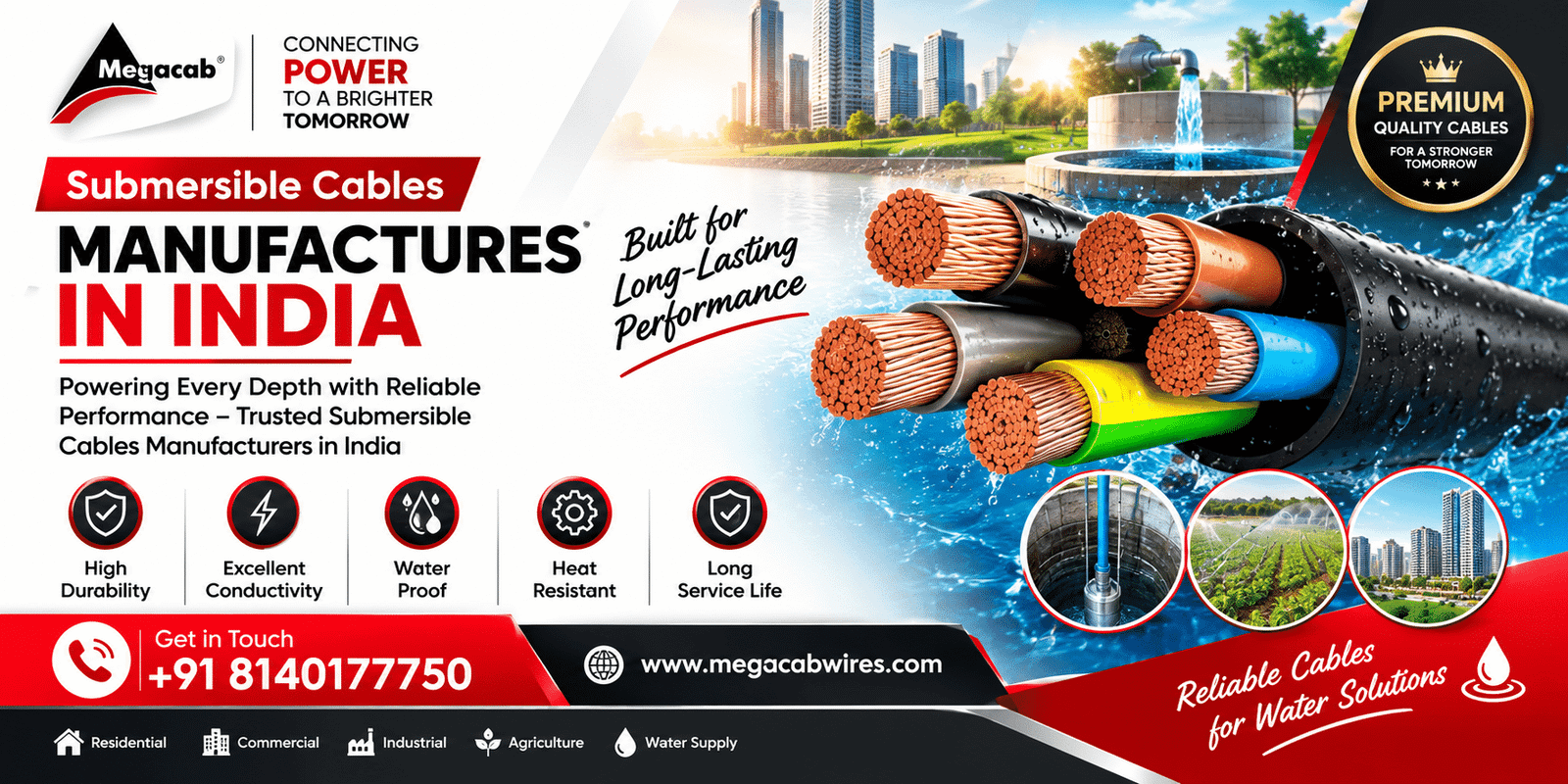
Submersible Cables Manufactures in India
Table of Contents
Introduction
Established in 2013 and headquartered in Rajkot, Gujarat (India), Megacab is a trusted name in the manufacturing, trading, and exporting of high-quality wires and cables. Built on a strong foundation of engineering excellence, innovation, and customer-first values, we deliver reliable electrical solutions that power homes, industries, and infrastructure across India and global markets.
Submersible cables play an important role in supplying electricity to water pumps used in agriculture, residential buildings, industries, and commercial projects. These cables are specially designed to work underwater and provide a reliable electrical connection between the power supply and the submersible pump. Choosing the right cable is essential for the safe and efficient operation of a pumping system.
India has a growing demand for submersible pumps due to the increasing need for irrigation, groundwater supply, industrial water management, and infrastructure development. As a result, the demand for high-quality submersible cables is also increasing. Buyers look for cables that offer good conductivity, flexibility, durability, and resistance to moisture.
Megacab aims to serve customers looking for dependable cable solutions for different electrical and industrial applications. When choosing among Submersible Cables Manufacturers in India, customers should consider cable quality, conductor material, insulation, technical specifications, and suitability for the intended application. We are the best Submersible Cables Supplier.
What Are Submersible Cables
Submersible cables are specially designed electrical cables used to connect submersible pumps with their power supply. These pumps operate below the water surface, so the cables must be suitable for wet environments and the operating conditions of the installation. We are the best submersible cable exporter.
Unlike ordinary electrical cables, submersible cables are designed with insulation and sheathing suitable for the intended underwater application. They are commonly used in borewell pumps, agricultural irrigation systems, domestic water pumps, and industrial pumping equipment.
A good submersible cable helps maintain a stable electrical connection, reduces the risk of electrical leakage when correctly selected and installed, and supports the efficient operation of the pump.
Importance of Submersible Cables in Pumping Systems
A submersible pump needs a reliable electrical supply to operate properly. The cable connecting the pump to the power source must handle the required current and voltage while withstanding the conditions of the installation.
- Reliable power transmission: Good-quality conductors help carry electricity efficiently to the pump.
- Moisture resistance: Suitable insulation and sheathing help protect the cable in wet operating environments.
- Mechanical flexibility: Flexible cables can be easier to install in borewells and other confined spaces.
- Long service life: Correctly selected cables can withstand normal operating conditions for longer periods.
- Pump protection: Proper cable sizing helps reduce voltage drop and overheating, supporting safe pump operation.
The actual performance of a cable depends on its design, materials, installation, and compliance with applicable standards. For these reasons, buyers should compare product specifications and work with dependable Submersible Cables Manufacturers in India.
Types of Submersible Cables
1. Flat Submersible Cables
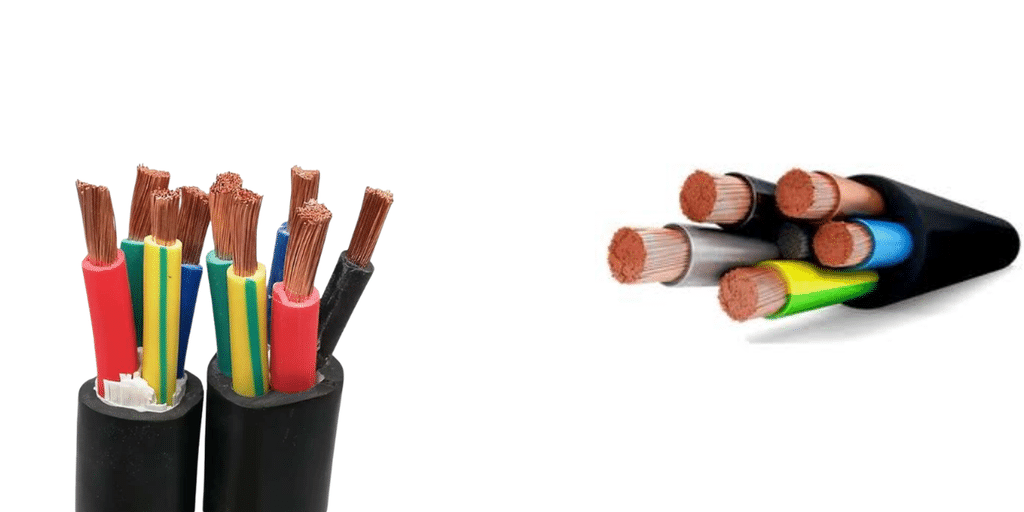
Flat submersible cables are widely used in borewell and deep-well submersible pump installations. Their flat shape makes them convenient to install alongside pump pipes in narrow spaces. These cables generally contain multiple insulated conductors arranged side by side and covered with a protective outer sheath.
Flat cables are commonly selected for agricultural and domestic water pumps because they are easy to handle and suitable for many vertical installations. Their flexibility also supports convenient cable routing during pump installation and maintenance.
2. Round Submersible Cables
Round submersible cables have conductors arranged within a circular cable structure. They are used in various pumping systems where a round profile is preferred for installation, handling, and connection requirements.
Depending on the cable design, these cables can provide mechanical protection and electrical insulation suitable for specified underwater applications. Buyers should check the manufacturer’s technical specifications before selecting a round cable for continuous submersible service.
3. PVC Insulated Submersible Cables
PVC-insulated submersible cables use polyvinyl chloride as an electrical insulation or sheathing material. They are commonly used in water pump installations where the cable’s rated voltage, temperature range, and environmental suitability meet the operating requirements.
These cables are available in different sizes and configurations to match the electrical needs of the pump. Buyers should verify that the complete cable construction is specifically suitable for submersible use rather than assuming that every PVC cable can operate underwater.
4. XLPE Insulated Submersible Cables
XLPE stands for cross-linked polyethene, a material used for electrical insulation in many power cable designs. XLPE insulation can offer good electrical properties and thermal performance when used within the cable’s specified operating limits.
XLPE-insulated cables may be considered for suitable pumping and power applications where their construction and water-resistance characteristics meet the requirements. The complete cable assembly, including its sheath, must be appropriate for continuous immersion if the installation requires it.
5. Copper Conductor Submersible Cables
Copper conductor submersible cables use copper wires to carry electrical current to the pump motor. Copper is valued for its high electrical conductivity, which can help reduce conductor losses when the cable is correctly sized for the installation.
These cables are used in different types of submersible pump systems, including agricultural, residential, and industrial installations. The required conductor size depends on motor current, cable length, voltage drop, installation conditions, and applicable electrical standards.
6. Aluminium Conductor Submersible Cables
Aluminium conductor cables use aluminium instead of copper for carrying electrical current. Aluminium can provide a lower conductor material cost and lower weight, but it generally requires a larger conductor cross-sectional area than copper for comparable electrical resistance.
These cables should only be selected when the pump terminals, connectors, cable construction, and installation method are compatible with aluminium conductors. Manufacturer guidance is especially important for submersible installations.
Applications of Submersible Cables
1. Agricultural Irrigation Systems
Agriculture is one of the major application areas for submersible cables in India. Farmers use submersible pumps to draw water from borewells, wells, and underground water sources for irrigation. These pumps require a dependable electrical supply to operate efficiently.
Submersible cables connect the power source to the pump motor, allowing water to be supplied to fields and crops. They are suitable for irrigation systems used in growing vegetables, fruits, grains, and other agricultural products.
High-quality cables help reduce the risk of electrical faults caused by moisture, insulation damage, and continuous operation. Selecting the correct cable size according to the pump’s power rating, operating voltage, and cable length is important for reliable agricultural performance.
2. Borewell and Deep-Well Pumps
Borewell and deep-well pumps are widely used in homes, farms, commercial properties, and industrial locations. These pumps are installed deep underground to extract water from groundwater sources.
Submersible cables are used to carry electrical power from the control panel to the submerged pump motor. Since these cables operate in challenging environments, they must have suitable insulation, flexibility, and water resistance for the intended installation.
Reliable cables support consistent pump operation and help minimise the risk of downtime. Manufacturers offer different cable constructions and conductor sizes to suit various pump capacities and installation requirements.
3. Domestic Water Supply
Submersible cables are commonly used in residential water supply systems. Individual houses, apartment complexes, housing societies, and residential buildings often depend on submersible pumps to obtain water from underground storage tanks and borewells.
These cables provide the electrical connection required to operate the pump and deliver water to overhead tanks, bathrooms, kitchens, and other household facilities.
For residential applications, selecting cables with appropriate insulation, current-carrying capacity, and mechanical strength is essential. Correct installation and regular inspection can help improve electrical safety and reduce unexpected pump failures.
4. Industrial Water Management
Many industries require a continuous supply of water for manufacturing, cooling, cleaning, and other operational activities. Submersible pumps are used in factories, warehouses, production facilities, and industrial plants to transfer water from wells, collection pits, and underground reservoirs.
Submersible cables help supply power to these pumps, supporting daily industrial operations. They may also be used in drainage systems and water collection areas, depending on the pump and cable specifications.
Industries should select cables according to their operating conditions, electrical load, installation depth, temperature, and exposure to chemicals or other environmental factors. Choosing the right cable helps maintain dependable equipment performance.
5. Water Treatment Plants
Water treatment plants use pumps to move water through different stages of treatment, storage, and distribution. Submersible pumps may be installed in collection tanks, sumps, reservoirs, and wastewater handling systems.
Submersible cables connect these pumps to the electrical supply, helping maintain the movement of water throughout the treatment process.
In such facilities, cables must be suitable for the specific liquid, installation environment, and pump operating conditions. Wastewater applications may require special consideration of chemical exposure and contamination. Selecting an appropriate cable construction helps support reliable operation and easier maintenance.
6. Drainage and Floodwater Removal
Submersible pumps are frequently used to remove unwanted water from flooded areas, basements, parking facilities, tunnels, and construction excavations. These systems are particularly important during heavy rainfall and waterlogging.
Submersible cables supply electricity to drainage pumps that transfer accumulated water to a designated discharge point. Reliable electrical connections are essential when pumps need to operate for extended periods.
For these applications, cable durability, insulation integrity, and correct installation are important. Pumps and cables must be suitable for the conditions in which they will operate, and electrical equipment should be protected against flooding wherever required.
7. Commercial Buildings and Infrastructure
Shopping centres, hotels, hospitals, office complexes, and large commercial buildings use pumping systems for water supply, drainage, and underground water management.
Submersible cables support pumps installed in underground tanks, collection pits, and borewells. They help ensure that electrical power reaches the pump motor so water can be transferred when required.
Commercial installations often need dependable equipment because pump failure can interrupt water supply or drainage operations. Using cables with suitable electrical ratings and insulation properties helps improve system reliability.
8. Mining and Quarrying Operations
Mining and quarrying sites may experience groundwater accumulation in pits, tunnels, and excavated areas. Submersible pumps are used to remove this water and maintain workable conditions.
Submersible cables connect these pumps to the power source. Because mining environments may involve rough handling, abrasive surfaces, and demanding operating conditions, cable selection must account for mechanical protection and the specific electrical requirements of the installation.
Industrial-grade cable solutions can help support pump operation when correctly matched to the equipment and maintained according to the manufacturer’s recommendations.
9. Municipal Water Supply Systems
Municipal water supply departments use pumps to extract and distribute water to residential areas, public facilities, and commercial establishments. Submersible pumps may be used in borewells, reservoirs, and groundwater extraction systems.
Submersible cables transmit electrical power to the pump motors that support these water supply operations. Reliable cables help reduce the possibility of interruptions caused by electrical connection problems.
For municipal applications, cable selection should consider pump capacity, voltage, installation depth, total cable length, and expected operating duration. Proper maintenance and periodic inspection also contribute to reliable water distribution.
Key Features to Look for in Submersible Cables
Before purchasing cables from Submersible Cables Manufacturers in India, buyers should evaluate several technical features.
1. High-quality conductor: The conductor should provide suitable electrical conductivity and meet the required current-carrying capacity.
2. Reliable insulation: Insulation must be appropriate for the operating voltage, temperature, and intended wet-service conditions.
3. Suitable sheathing: The outer sheath should provide protection against the mechanical and environmental conditions expected during installation and use.
4. Flexibility: Flexible construction can simplify cable handling and installation in borewells and confined spaces.
5. Correct voltage rating: The cable’s rated voltage must match the electrical system and applicable requirements.
6. Appropriate temperature rating: The cable should be suitable for the expected operating temperature and surrounding environment.
7. Compliance with standards: Check the relevant Indian or applicable product standards, test reports, and manufacturer documentation before purchasing.
Why Choose Megacab
When customers search for Submersible Cables Manufacturers in India, they want cable solutions that meet their electrical requirements and offer dependable performance. Megacab is a company to consider when exploring cable options for pumping and related electrical applications.
Megacab can be promoted to buyers seeking cable products for agricultural, domestic, commercial, and industrial requirements. Customers should confirm the available submersible cable range, conductor options, sizes, technical specifications, and applicable certifications directly with the company before making a purchase.
Reasons buyers should consider when evaluating Megacab include:
- Application-focused selection: Choose products according to the requirements of your pump and installation.
- Technical specifications: Review conductor size, insulation, voltage rating, and other important product details.
- Suitable product options: Identify cable configurations that match the intended pumping application.
- Quality evaluation: Request relevant technical documents and test information before ordering.
- Support for buyers: Discuss project requirements, cable lengths, and installation conditions with the company’s sales team.
By focusing on the right specifications and application requirements, Megacab can help customers make informed decisions when sourcing cable solutions.
Frequently Asked Questions (FAQs)
1. What are submersible cables used for?
Submersible cables connect submersible pump motors to a power supply. They are used in borewells, agricultural irrigation systems, residential water supply, and industrial pumping applications.
2. How do I select the correct submersible cable size?
Consider the motor’s power rating, current, voltage, cable length, installation depth, and permissible voltage drop. A qualified electrical professional can help determine the appropriate size.
3. Which conductor is commonly used in submersible cables?
Copper is commonly used because of its good electrical conductivity. The appropriate conductor material and size depend on the application and product specifications.
4. Are submersible cables suitable for continuous water immersion?
Only cables specifically designed and rated for the intended immersion conditions should be used. Always check the manufacturer’s technical documentation.
5. Where are submersible cables commonly used in India?
They are used in agriculture, borewell pumping, residential buildings, commercial facilities, industrial water systems, and water supply projects.
6. Why is insulation important in submersible cables?
Insulation helps prevent electrical leakage and protects the conductors from moisture and other environmental factors when the cable is correctly rated and installed.
7. How can I find suitable Submersible Cables Manufacturers in India?
Compare product specifications, quality documentation, applicable certifications, product availability, technical support, and suitability for your pump system.
8. How can I enquire about submersible cables from Megacab?
Contact Megacab through its official business channels to confirm available cable types, conductor sizes, technical specifications, pricing, and delivery options.
Conclusion
Submersible cables are essential components in agricultural irrigation, residential water supply, industrial pumping, construction dewatering, and water treatment systems. Selecting the right cable helps support safe electrical operation, dependable power transmission, and long-term performance. We are the best Submersible Cables Exporter in Rajkot.
When comparing Submersible Cables Manufacturers in India, buyers should pay attention to conductor material, cable size, insulation, voltage rating, environmental suitability, and quality documentation.
Megacab can be included in your search for suitable cable solutions. By discussing your application requirements and checking the available product specifications, you can identify an appropriate cable for your pumping system.